The advent of radio during the First World War laid the groundwork for a new era of mass communication in the United States. This technology, initially used for strategic military operations, quickly found its way into civilian life. The establishment of station 8MK in Detroit, a pioneering event in the world of commercial radio, represented the first step in bringing real-time news coverage into American households. This watershed moment occurred on August 31, 1920, when the station delivered its first broadcast, covering local election results. The momentum did not stop there; later the same year, Pittsburgh saw the establishment of KDKA, another landmark in the history of commercial radio. By 1922, regular entertainment programming had begun, marking the start of radio’s golden age. This was not merely the emergence of a new medium, but the dawn of an era that forever changed how people receive information and entertainment.
In the early months of 1922, the American Telephone and Telegraph (AT&T) announced a significant development in the realm of commercial radio: the introduction of advertisement-supported broadcasting on its stations. This signaled a paradigm shift in the business model for radio, as it established a new source of revenue and marked the beginning of the commercialization of airwaves. However, this journey was short-lived for AT&T. By July 1926, the telecommunication giant decided to withdraw from the broadcasting field. AT&T’s entire network operations were sold to a consortium led by the Radio Corporation of America (RCA). Utilizing these acquired assets, RCA established the National Broadcasting Company, a monumental development in the history of radio and mass communication.
With the establishment of radio broadcast networks, the pressing need for new forms of entertainment became apparent in order to occupy the broadcast day of a station. Initially, network programs were almost entirely presented live. This practice led to an intriguing broadcasting routine for prime-time shows, which were performed twice; once for the Eastern coast and once for the Western coast. This dual performance provided a unique and entertaining experience for the listeners, who got to enjoy their favorite shows live, irrespective of their location. The live broadcasts encapsulated the vibrancy and immediacy of the radio era, bringing a sense of shared experience to the audience spread across the vast American landscape.
Radio stations soon recognized the need to diversify their content beyond just news broadcasts, in order to appeal to a broader audience. This need led to the creation of a variety of different program formats, one of the most popular being the sponsored musical feature. Much of the early radio sponsorship came in the form of selling the naming rights to the program. Examples of these include “The A&P Gypsies”, “Champion Spark Plug Hour”, “The Clicquot Club Eskimos”, and “King Biscuit Time”.
In addition to these sponsored programs, radio also saw an influx of classical music broadcasts. These included “The Voice of Firestone” and “The Bell Telephone Hour”, along with the Metropolitan Opera radio broadcasts sponsored by Texaco. Renowned songwriters, such as George Gershwin, featured prominently in radio programming, further enriching the musical diversity of the airwaves. Furthermore, the New York Philharmonic established a strong radio presence with their weekly concerts, bringing the delight of orchestral music to homes nationwide. This period signified the diversification of radio content, offering a greater variety of entertainment to the American public.
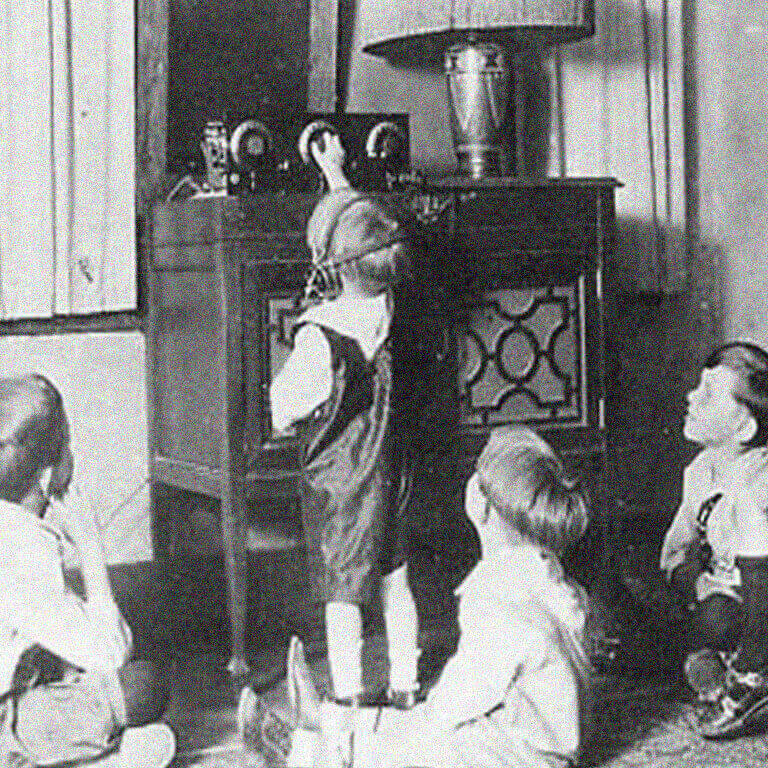
As the decade progressed, radios began to permeate the average American household. In the mid-1920s, owning a radio was somewhat of a luxury, with the cost around $150 – equivalent to over $1,000 in today’s currency. However, technological advancements and mass production gradually reduced the cost, making radios more accessible for the common man. By the 1930s, the price had dropped significantly and radios had become a common sight in most American homes. The radio quickly evolved from a luxury item to a home necessity, transforming the way families spent their leisure time. It became the centerpiece for family entertainment, with family members gathering around the radio each evening to listen to news, music, and dramatic programming. The radio era, which began its spark in the 1920s, had fully ignited by the 1930s, setting the stage for an unprecedented evolution in mass communication and entertainment.